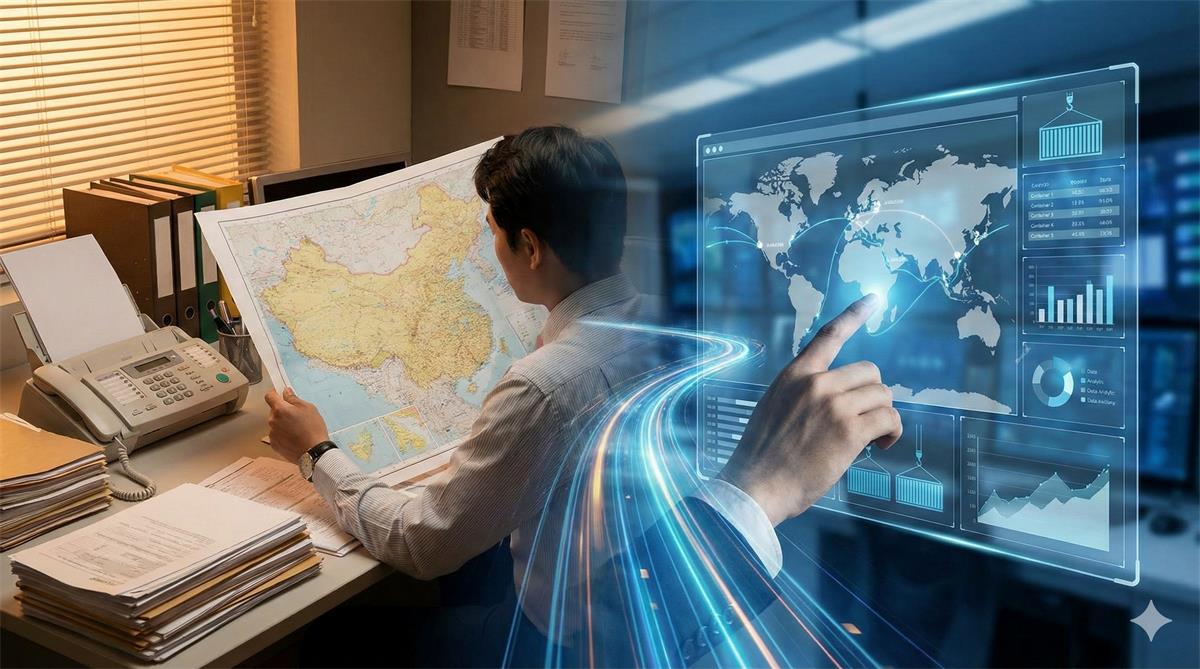
Over the past decade, that landscape has shifted. A new wave of digital-first platforms now offers instant quotes, self-service booking, real-time tracking, automated documentation, and user-friendly dashboards. Investment in digital logistics has surged, and adoption of AI, advanced analytics, and automated workflows is accelerating. This raises an inevitable question for traditional forwarders: Are digital forwarders replacing traditional agents, or empowering them?
The honest answer: they are both. Traditional agents that ignore the shift will lose relevance; those that embrace it can reposition themselves at the center of complex, higher-margin work.
What Exactly Is “Digital Forwarding”?
Definitions vary, but digital-first freight forwarders and platforms typically share several traits:
-
A technology-first operating model
-
Online dashboards for quotes, bookings, and tracking
-
Automated workflows for documentation, status updates, and invoicing
-
A strong focus on speed, transparency, and user experience
> Where many traditional forwarders rely on emails, Excel, and manual coordination, digital players centralize communication and execution in a single system.
The key differences include:
Technology adoption: Digital forwarders are built around integrated platforms and APIs; traditional agents often juggle fragmented tools.
Pricing transparency: Digital based forwarders offer instant online quotes and clear cost breakdowns; traditional quoting often requires back-and-forth communication.
Automated Workflows: Documentation, status updates, and invoicing happen automatically, reducing the need for "check-in" emails.
User Experience: A focus on 24/7 dashboards and chat portals rather than standard business-hour phone support.
Today, the divide is less “digital vs. analog” and more: fully digital, partially digital, or not digital enough.
Where Digital Forwarding Represents a Real Threat
Digital platforms don’t just digitize old processes; they change how value is perceived. For traditional agents, the threats are structural:
Margin Compression Through Transparency
Online platforms expose market rates in real time. With digital freight brokerage projected to grow dramatically, shippers can benchmark offers instantly. This makes it harder to:
-
Charge relationship based premiums without clear added value, Hide surcharges or inefficient routings
-
Defend higher margins in transactional business
Disintermediation Risk
Self-service tools encourage shippers, especially SMEs, to manage basic freight independently:
-
Generating quotes
-
Comparing multiple carriers
-
Booking and tracking end-to-end
For standard FCL or simple air freight, this can bypass traditional agents entirely.
Speed and Scalability
Digital players automate repetitive work such as quoting, schedules, documentation, and reminders. This leads to:
-
Faster response times
-
Higher productivity per operator
-
Lower cost per shipment
Traditional forwarders relying heavily on manual steps operate at a structural disadvantage regarding speed and overhead.
Changing Customer Expectations
Modern customers expect:
-
24/7 visibility
-
Online self-service
-
Fewer calls and clearer records
Digital forwarders naturally meet these expectations; traditional agents that rely on email alone risk appearing outdated.
Why It’s Not “Game Over” for Traditional Agents
Despite predictions, digital platforms have not eliminated traditional forwarders. Instead of a full digital takeover, the industry is settling into a hybrid model, where technology handles efficiency and scale, while human expertise covers complexity, risk, and relationships. The resilience of traditional agents is not accidental; it reflects structural realities of how global logistics actually operates. This becomes clear when looking at where purely digital models still fall short:
Complexity, Exceptions, and Judgment: Digital systems excel at standardization, but logistics is often messy. Algorithms struggle with:
-
Non standard cargo (OOG, DG, reefer, or high-value cargo)
-
Complex routings or politically sensitive markets
-
Port disruptions, strikes, regulatory surprises, last-minute changes
In these scenarios, experienced forwarders with deep local knowledge provide value that a generic platform cannot replicate.
Relationship Capital: Digital platforms are still building credibility with carriers, customs, terminals, and local authorities. Traditional forwarders often have decades of trust built into those relationships- a competitive advantage when issues arise.
The Market Is Expanding: Global trade volumes continue to grow. Digitalization lowers barriers, enabling more SMEs to trade and opening new routes. Rather than dividing a fixed pie, the market is expanding, creating room for both digital platforms and traditional agents.
The Human Demographic Factor: Logistics is a deeply human industry. For example, the U.S. trucking and logistics workforce is highly diverse; approximately 48.4% of drivers identify as minorities, and a significant portion of owner-operators are immigrants or first-generation business owners. These groups often prefer working with human agents who understand cultural nuances, language barriers, and specific relationship dynamics- nuances that an app often misses.
New Roles Traditional Forwarders Can Play
The "Old School" model of manual data entry is dying, but the answer isn't to become a software company. The answer is to adopt strategic, high-value roles.
Orchestrator on Top of Digital Platforms
Rather than compete with every platform, a traditional forwarder can act as the architect:
-
Use digital marketplaces as a capacity source for rates or spot loads.
-
Combine marketplace options with contracted carriers
-
Wrap the service with consulting, documentation, financing, risk management, and local execution
> In this model, platforms supply data and automation; the forwarder architects the solution.
Specialist Micro-Networks
As digital platforms commoditize general freight, forwarders can specialize in areas where expertise matters most:
-
Pharmaceuticals and cold chain
-
Oversized and project cargo
-
Cross-border e-commerce lanes
-
High-risk or sanctioned regions requiring strict compliance.
These micro-networks can run on digital infrastructure but differentiate through domain mastery, not volume.
The "Deep End" Strategy
Instead of competing with freight marketplaces to move standard 40ft containers on major lanes (a race to the bottom on price), forwarders should double down on complex, high-touch shipments. These "messy" shipments command a premium because they require human oversight.
The Hybrid Model: Tech-Powered, Human-Led
This model uses technology to handle the transaction, freeing the human to handle the relationship. How to execute:
- Stop building, start partnering.
- Instead of building your own portal, use white-label systems. Rent the tech; own the relationship.
- Human-in-the-loop workflows.
- Let AI generate quotes, run landed-cost analysis, and check schedules, but have an agent validate critical details before sending.
- Data as a Service: Forwarders traditionally gave away insights. Today, data itself is a billable value-add:
- Carbon footprint reporting
- Supplier scorecards
- Landed cost modeling
- Predictive routing advice
- Platforms automate data; forwarders interpret it.
Rebranding the Role: From “Forwarder” to “Supply Chain Architect”
The most radical shift is psychological. If you view yourself as someone who "moves boxes," you are a commodity. If you view yourself as a Consultant, you are indispensable.
The "Consultative Pivot" examples:
-
Old Way: "Here is your quote for the LCL shipment."
- New Way: "I see you're shipping LCL every week. If we consolidated this at origin, we could save you 15% and reduce damage risk."
Digital platforms provide visibility; traditional agents provide foresight.
Conclusion: The Best of Both Worlds
Digital forwarding is a threat- but only to those who remain slow, opaque, or resistant to change.
For forwarders who embrace digital tools while amplifying their human strengths, the industry is full of opportunity. The market is already splitting:
-
The Vending Machine: fast, automated, low-touch
-
The Concierge: expert, accountable, resilient
Traditional agents who combine digital efficiency with human expertise won’t just survive.
They will win the most valuable segment of the market- the customers who know that when the storm hits, an algorithm can’t pick up the phone. But you can.